
Die casting is an advanced metal forming process that injects molten metal into a mold cavity under high pressure and allows it to solidify into precise components. Due to its high production efficiency, excellent dimensional accuracy, and superior surface quality, die casting is widely used in automotive components, electronics, telecommunications equipment, medical devices, and industrial applications.
A high-quality die casting mold is essential for ensuring product accuracy, production stability, and manufacturing efficiency. The design and manufacturing quality of the mold directly affects part performance, production costs, and mold service life. This article explains the complete process of die casting mold design and manufacturing.
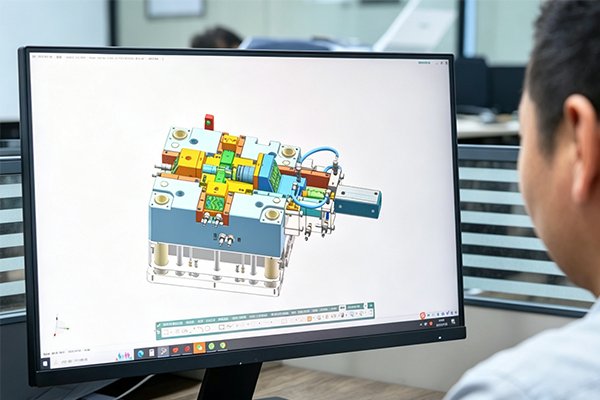
1. Die Casting Mold Design Process
Mold Structure Design
A die casting mold typically consists of a fixed mold, movable mold, core pulling system, ejection system, and gating system.
During the mold design process, engineers must consider product geometry, molten metal flow direction, gate location, venting design, parting line selection, and manufacturing feasibility.
A well-designed mold structure helps improve filling performance, reduce casting defects, and ensure excellent dimensional accuracy and surface quality.
Mold Material Selection
Die casting molds operate under extreme conditions involving high temperatures, high pressure, and repeated metal impact. Therefore, mold materials must provide excellent heat resistance, strength, toughness, and wear resistance.
Common materials include high-performance hot work tool steels and alloy steels. Proper material selection improves mold durability and ensures stable production performance.
Mold Surface Treatment
The surface quality of a mold directly affects casting appearance, release performance, and mold lifespan.
Common surface treatment processes include polishing, nitriding, EDM machining, sand blasting, and surface strengthening treatments.
Optimized surface finishing improves casting consistency and reduces surface defects.
2. Die Casting Mold Manufacturing Process
CNC Precision Machining
CNC precision machining is one of the most important processes in modern mold manufacturing.
Using advanced machining centers, CNC milling machines, EDM equipment, and wire cutting machines, manufacturers can achieve high-precision machining of mold cavities, sliders, and complex components.
Advanced CNC machining technology ensures dimensional accuracy, improves efficiency, and meets the requirements of complex aluminum die casting components.
Manufacturing Process Control
Strict process control is required throughout mold manufacturing, including:
- Material inspection
- Rough machining
- Semi-finishing
- Precision machining
- Heat treatment
- Dimensional inspection
A comprehensive quality control system ensures that molds meet design requirements and provide stable performance during mass production.
Mold Assembly and Testing
After machining, the mold undergoes precision assembly, trial production, and adjustment.
During mold testing, engineers evaluate filling performance, dimensional accuracy, surface quality, and mold operation conditions. Necessary adjustments are made to optimize mold performance.
A fully tested mold ensures stable die casting production, improved product quality, and reduced manufacturing costs.
Conclusion
Die casting mold design and manufacturing is a comprehensive process that integrates product engineering, material technology, precision machining, and manufacturing expertise.
Only through scientific mold design, advanced manufacturing processes, and strict quality control can manufacturers produce high-precision and reliable die casting molds for mass production.
Professional tooling development capabilities help improve product quality, shorten production cycles, reduce manufacturing costs, and provide greater value for customers.